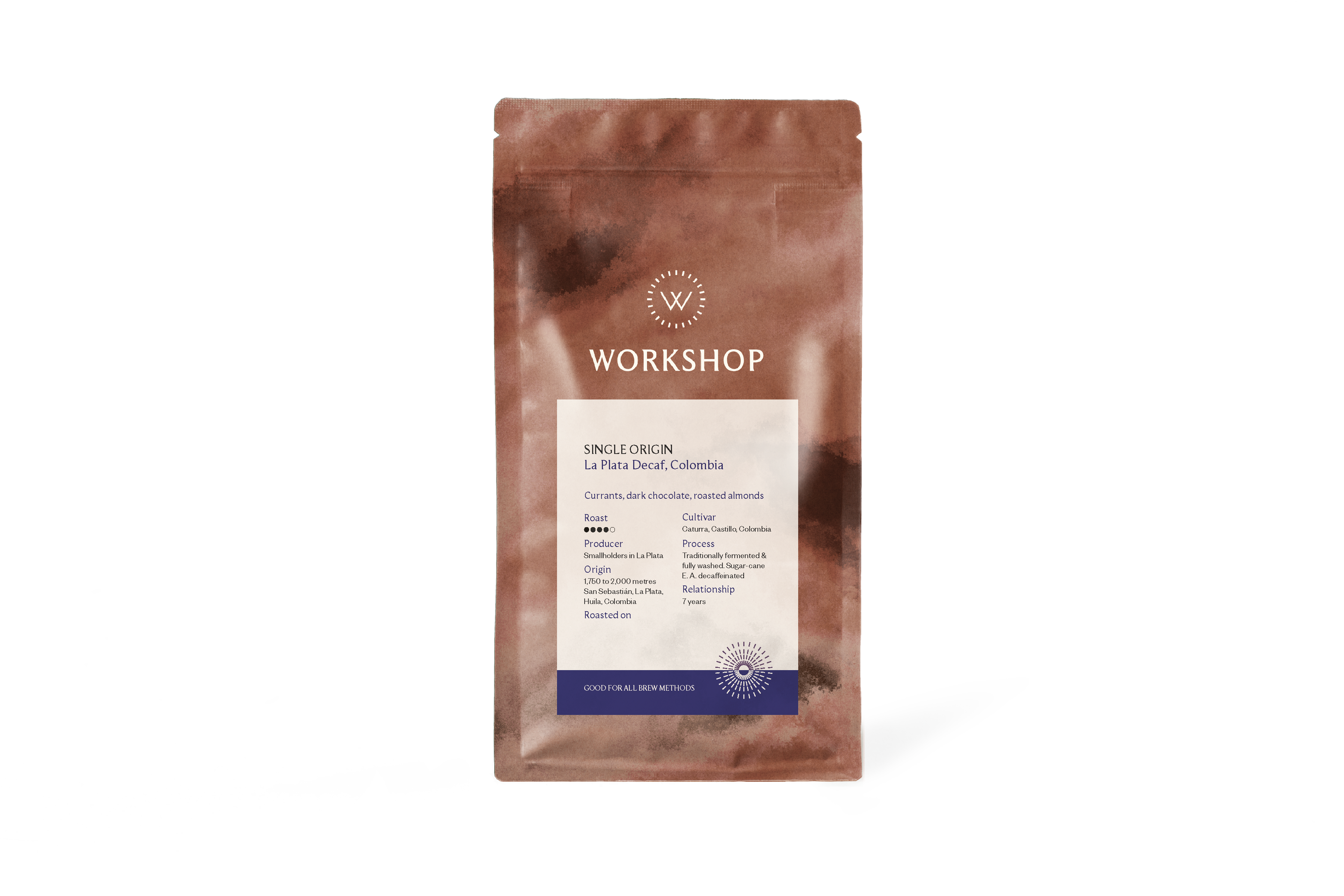
Suitable for espresso and filter brewing, expect a creamy, balanced decaffeinated espresso with sweet fruit notes of currants and prunes. The finish is like dark chocolate and roasted almonds. Roasted for all brew methods. Paying close attention to all the coffees we buy means we have always treated our decaf purchases with the same care and rigour as all lots we buy; this year we have selected an entire lot to be decaffeinated in Colombia that creates a creamy, balanced coffee. The lot comes from seven smallholder farmers around San Sebastian in La Plata, Huila, among them Gina Samara Jalvin, Gloria Isabel Garcia, Ivonne Andrea Oviedo and Laura Ramirez, growing Caturra, Castillo and Variedad Colombia between 1,750 and 2,000 metres with shade and nitrogen-fixing trees such as Cambulo, Guamo and Cedro alongside native species. Cherries are hand picked when fully ripe, traditionally depulped and fermented, fully washed and dried on covered patios or in polytunnels. The coffee is then decaffeinated at Descafecol using the Sugar Cane Ethyl Acetate process, in which the solvent derived from fermented sugarcane alcohol is combined with local spring water to bring caffeine content below 0.1%, all without shipping the coffee between countries for processing. The coffee is exported by Caravela, whose 80/20 model favours smallholders and whose Coffee Growers Education Programme (PECA) supports 1,746 Colombian producers across 52 communities.
Roaster Notes
"Seven smallholder producers around San Sebastian, La Plata, Huila, Colombia (including Gina Samara Jalvin, Gloria Isabel Garcia, Ivonne Andrea Oviedo and Laura Ramirez), farming at 1,750-2,000 metres. Varieties Caturra, Castillo and Variedad Colombia. Hand picked ripe cherry, traditionally depulped and fermented, fully washed and dried on covered patios or in polytunnels. Decaffeinated at Descafecol in Colombia by the Sugar Cane Ethyl Acetate method (solvent from fermented sugarcane alcohol plus local spring water) to below 0.1% caffeine, avoiding multi-country shipping; Workshop has used only this method for eight years. Shade and nitrogen-fixing trees (Cambulo, Guamo, Cedro and natives) support biodiversity. Exported by Caravela, 80/20 smallholder model, PECA education programme reaching 1,746 producers in 52 communities. Recipes: espresso 18g in, 38g out, 30-32s, 93.5C, 9 bar; filter 70g/L at 95C; pourover 21g to 300g water, 30s bloom, 3:30 total."
Suitable for espresso and filter brewing, expect a creamy, balanced decaffeinated espresso with sweet fruit notes of currants and prunes. The finish is like dark chocolate and roasted almonds. Roasted for all brew methods. Paying close attention to all the coffees we buy means we have always treated our decaf purchases with the same care and rigour as all lots we buy; this year we have selected an entire lot to be decaffeinated in Colombia that creates a creamy, balanced coffee. The lot comes from seven smallholder farmers around San Sebastian in La Plata, Huila, among them Gina Samara Jalvin, Gloria Isabel Garcia, Ivonne Andrea Oviedo and Laura Ramirez, growing Caturra, Castillo and Variedad Colombia between 1,750 and 2,000 metres with shade and nitrogen-fixing trees such as Cambulo, Guamo and Cedro alongside native species. Cherries are hand picked when fully ripe, traditionally depulped and fermented, fully washed and dried on covered patios or in polytunnels. The coffee is then decaffeinated at Descafecol using the Sugar Cane Ethyl Acetate process, in which the solvent derived from fermented sugarcane alcohol is combined with local spring water to bring caffeine content below 0.1%, all without shipping the coffee between countries for processing. The coffee is exported by Caravela, whose 80/20 model favours smallholders and whose Coffee Growers Education Programme (PECA) supports 1,746 Colombian producers across 52 communities.
Roaster Notes
"Seven smallholder producers around San Sebastian, La Plata, Huila, Colombia (including Gina Samara Jalvin, Gloria Isabel Garcia, Ivonne Andrea Oviedo and Laura Ramirez), farming at 1,750-2,000 metres. Varieties Caturra, Castillo and Variedad Colombia. Hand picked ripe cherry, traditionally depulped and fermented, fully washed and dried on covered patios or in polytunnels. Decaffeinated at Descafecol in Colombia by the Sugar Cane Ethyl Acetate method (solvent from fermented sugarcane alcohol plus local spring water) to below 0.1% caffeine, avoiding multi-country shipping; Workshop has used only this method for eight years. Shade and nitrogen-fixing trees (Cambulo, Guamo, Cedro and natives) support biodiversity. Exported by Caravela, 80/20 smallholder model, PECA education programme reaching 1,746 producers in 52 communities. Recipes: espresso 18g in, 38g out, 30-32s, 93.5C, 9 bar; filter 70g/L at 95C; pourover 21g to 300g water, 30s bloom, 3:30 total."